TrailFlow
Bridge between hydration and strategic planning for Burke-Gilman Trail users
About
Context
TrailFlow is a project developed as part of the upper-level undergraduate courses HCDE 302 and 303 in Human Centered Design & Engineering at the University of Washington during the 2024-2025 academic year. Over six months, our team focused on enhancing accessibility to water fountains along the Burke-Gilman Trail, aiming to improve the experience for those engaging in the trail's activities.
Problem Statement
"How can we improve access to hydration for runners on the Burke-Gilman Trail while making it affordable and convenient?"
Vision Statement
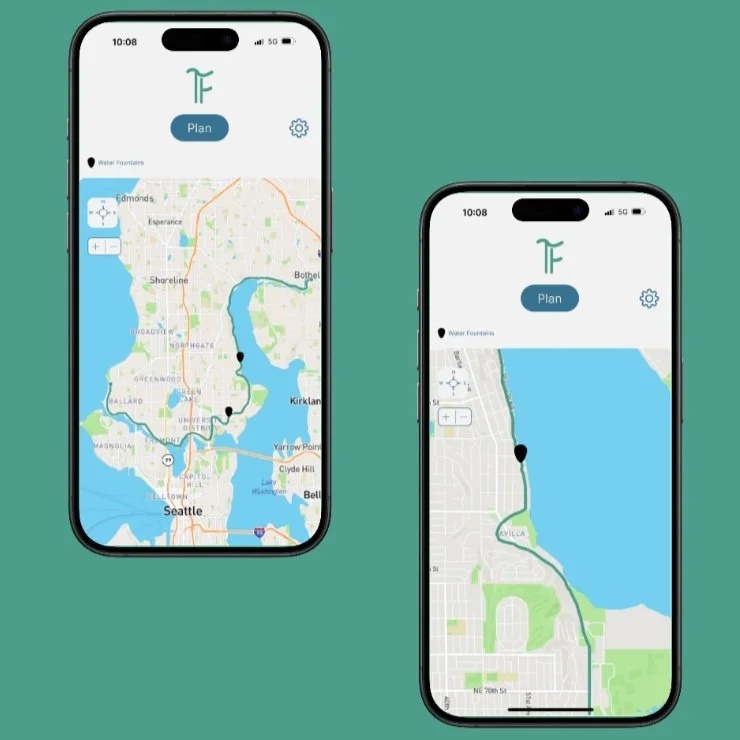
Our project envisions a future where access to hydration is seamless and convenient for all trail users. By designing an intuitive app, we aim to help users easily locate water fountains, plan routes, and stay informed about maintenance updates, ensuring a more enjoyable and well-hydrated experience on the trail.
Research
Findings
Our research phase involved a competitive analysis of existing hydration solutions and interviews with four college students who run on the Burke-Gilman Trail. Through this process, we identified three key findings that shaped our ideation and design decisions, allowing us to focus on the most impactful user needs.
User Personas
To gain a deeper understanding of our target users, we created detailed user personas based on our research insights. These personas — Jill and Jonny — helped us synthesize our findings and provided a reference point throughout the design process. Jonny, in particular, served as the foundation for our user journey map, ensuring our decisions were grounded in real user experiences.
User Journey Maps
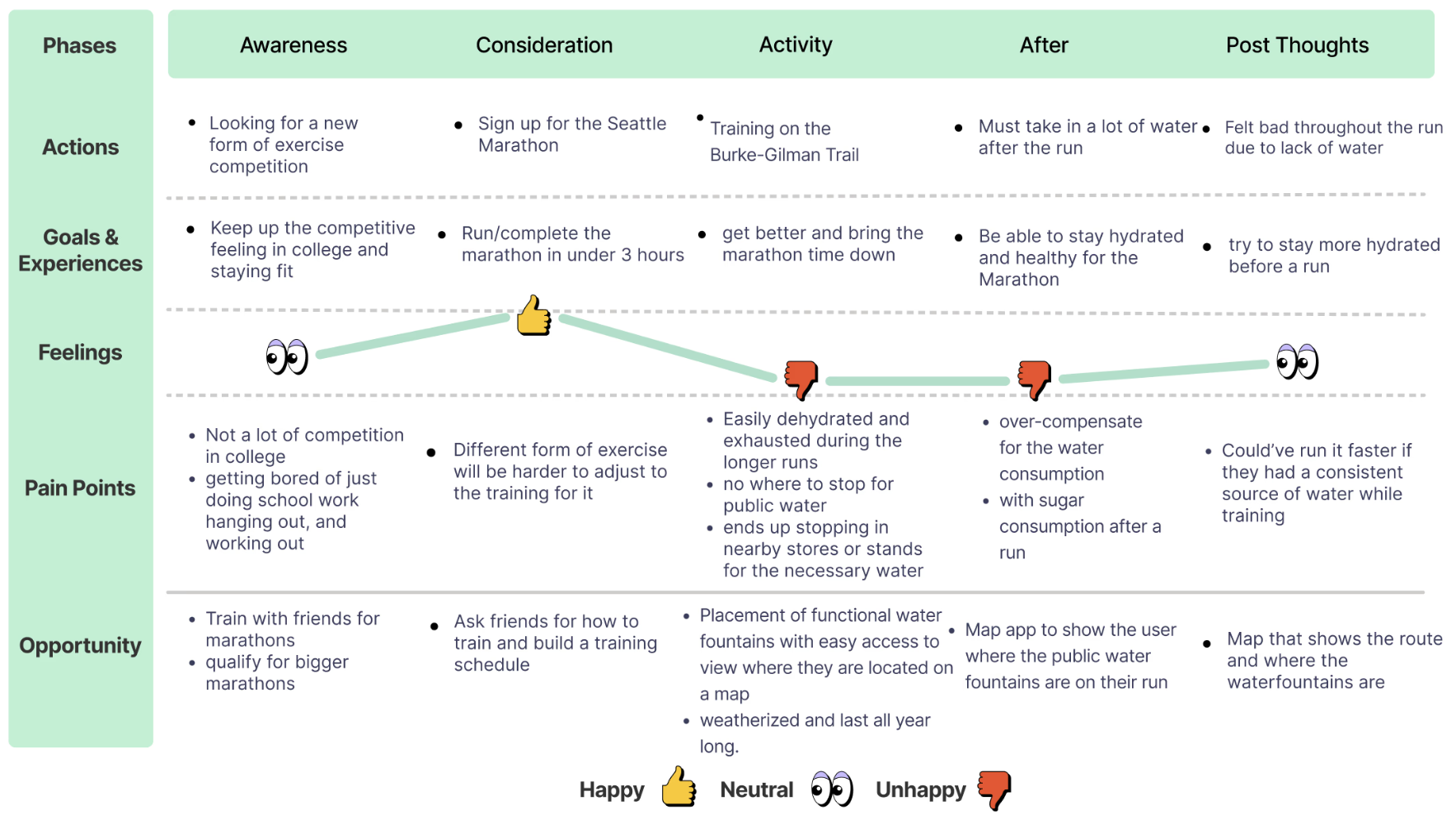
Our user journey map for Jonny Jones outlined the marathon training experience, highlighting key actions, thoughts, and emotions throughout his journey. This visualization helped us identify major pain points and opportunities to enhance the user experience, ensuring our design addressed the real challenges runners face.
Built upon our research and persona development, our journey map provided a structured framework for understanding the obstacles our users encounter. It served as a crucial reference point throughout our design process, allowing us to continuously align our solutions with user needs and expectations.
Design Requirements
Our design requirements established clear guidelines for our product's features and functionalities, providing a roadmap to ensure TrailFlow met both user needs and product goals. These requirements, directly informed by our research and personas, helped us create wireframes and prototypes that remained user-centered.
Following our design review, we recognized that implementing all design requirements would be challenging. As a result, we prioritized four key aspects: Locate, Usability, Updates, and Maintenance — focusing on the most essential elements to deliver a functional and impactful solution.
Portability
Did not like to carry anything on them for multiple reasons
1
2
Hydration
Consuming different forms of hydration to stay hydrated
Jill Jones
An undergraduate student at the University of Washington studying Computer Science. She works for app development at REV
Jill runs daily for her mental and physical health, a habit from her high school Cross Country and Track days. While she tries to stay hydrated, she sometimes forgets to drink enough water throughout the day. On her long runs, she often feels thirsty and struggles with dry mouth after taking her gels, which she relies on for energy. Jill prefers running at Greenlake but finds the water fountains there crowded or inconvenient to access during peak times.
Resources:
Uses Google Maps to look at a map
Goals:
Training for the Boston Marathon after having qualified for it at the Eugene Marathon last year
Stays hydrated throughout her day
Look for flat parts on her running loops to complete workouts on, but also include hills to train on because her Seattle Half Marathon will be very hilly
Pain points:
Typically schedules her runs on Greenlake because of the amount of water fountains there
Only water fountains on Burke-Gilman are outside of the Brooks store, Gasworks park, outside of Trailside, and outside of UVillage
Not a fan of the bikers on the Burke
Has had issues with cars crossing the Burke
Safety
Did not feel safe for various reasons during their run

4
Ideation
Jonny Jones
An undergraduate student at the University of Washington studying Bioengineering. He works down at UVillage at GAP.
Jonny, a marathon trainee seeking competition after high school sports like basketball and baseball, drinks about half a gallon of water daily but often forgets. He does long runs on weekend mornings to start his day and shorter runs between weekday classes. While running the Burke-Gilman Trail, he often feels dehydrated due to not hydrating enough the night before. He completes long runs with friends for motivation
Resources:
Uses Strava to track runs
Goals:
Training for a sub 3 hour Seattle Marathon
Stay healthy and hydrated
Include many hills in his routes to help train for the hilly Seattle Marathon
Pain points:
Feels dehydrated during long runs on weekends because he forgets to drink water the night before
Struggle to find functional water fountains on Burke (3 of them never work) and is forced to stop at stores
Often gets bored with a long run on the Burke
3
Locate
Enable runners to locate the nearest hydration source
1
2
Usability
Design the system to be intuitive and user-friendly
Updates
Offer real-time updates on hydration source functionality
Maintenance
Facilitate rapid reporting and resolution of issues