Overview
Accessibility is a critical consideration in product design. Many products unintentionally exclude certain users, limiting their functionality and reach. This issue resonated deeply with me, inspiring my team and me to redesign a portable phone microscope holder to make it universally compatible with all smartphones.
As the design lead for our group project in ENGR 115A: Engineering Transformation of Health, Winter 2022, at the University of Washington, I spearheaded the creative and technical efforts, focusing on developing a practical, accessible, and innovative solution to overcome the limitations of existing designs.
Background
Microscopes play an essential role in science, from education to biomedical research. Portable phone microscopes have gained popularity as an affordable and convenient alternative to traditional microscopes, particularly in low-resource settings. These devices allow users to perform tasks such as blood cell counting and tissue analysis, making science more accessible.
However, many existing portable microscope designs are limited in their functionality:
Limited in compatibility with non-iPhone devices.
Constrained to a single zoom level.
Bulky, expensive, or difficult to use.
This challenge presented an opportunity to innovate. Our goal was to create a universally compatible, affordable, and portable phone microscope holder. My role as design lead was to ensure that our final design met our accessibility and functionality goals while staying true to the constraints of low cost and portability.
The Design Process
Identifying Challenges
Microscopes are fundamental tools in science, enabling the exploration of the microscopic world. However, traditional microscopes are costly, bulky, and often inaccessible for non-professional use. As smartphone ownership continues to rise globally, smartphone-based microscopes offer a promising, low-cost alternative, though existing designs face several challenges. These include limited zoom functionality, incompatibility with various phone models, and high prices. The goal of this project was to create a universally accessible, portable, and affordable microscope that could be used with a wide range of smartphones, catering to both scientific and educational needs.
With nearly 50% of the global population owning smartphones, the potential to leverage these devices as microscopes offers an exciting opportunity to democratize scientific exploration. However, existing smartphone microscopes typically suffer from one or more significant drawbacks. Most designs either fail to fit a variety of phone types, lack adjustable zoom functionality or are prohibitively expensive for general use. Our solution aimed to overcome these issues by creating an adaptable, user-friendly product that could be used by anyone, anywhere.
Exploring Existing Solutions
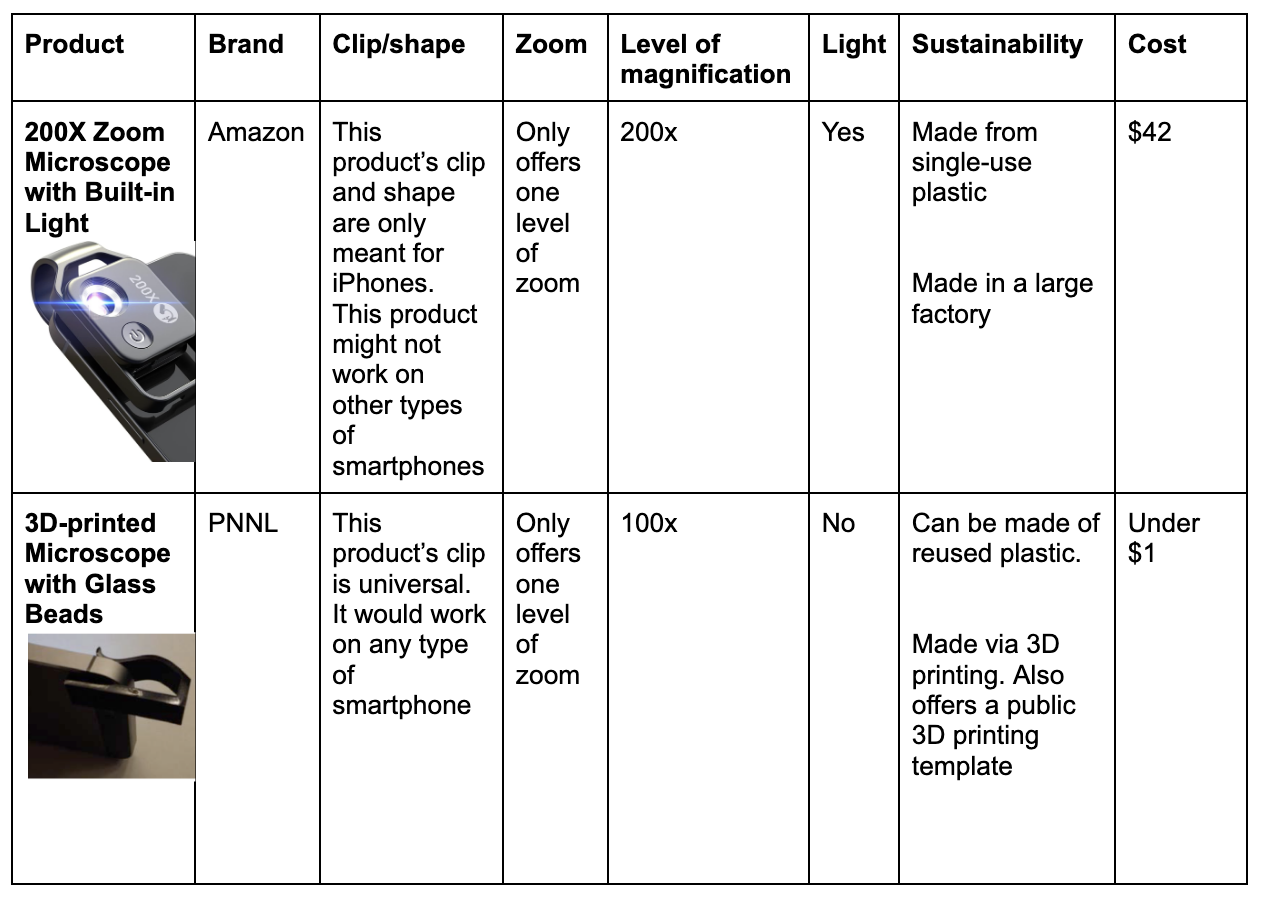
In exploring current smartphone microscope designs, we found a range of solutions, from simple clip-on magnifiers to more sophisticated USB-powered microscopes. However, these solutions generally shared common issues:
1 Limited Compatibility: Many clip-on microscopes only worked with specific phone models or configurations.
2 Single Zoom Level: Many of these microscopes offered only one zoom level, reducing their versatility.
3 Bulky and Expensive: Many designs were either too large to be portable or too costly for general use.
We explored two primary designs in detail:
• 3D-Printed Microscope with Glass Beads: This simple design relied on glass beads to magnify images. While affordable and customizable, the design only allowed for a single zoom level and was incompatible with certain phone types.
• 200X Zoom Microscope with Built-in Light: This commercially available microscope offered a higher magnification, but it was only compatible with iPhones and had limited adjustability for positioning, making it unsuitable for a wider audience.
Both solutions highlighted the same critical problem: existing designs lacked universal compatibility and scalability in terms of zoom.
Concept Development and Iteration
Initial Ideas
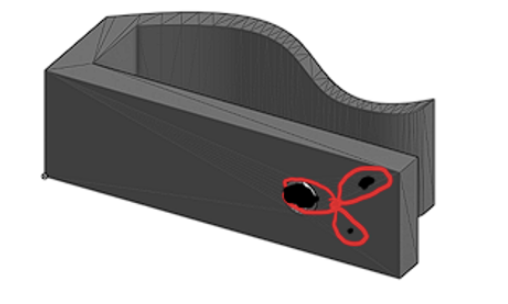
I began with a simple clip-on design inspired by the Pacific Northwest National Laboratory’s 3D-printed microscope clip. This design used glass beads to simulate zoom levels. However, during testing, I discovered several issues:
Beads were too small to align accurately with the phone’s camera.
The single-clip design caused stability issues, obstructed part of the phone screen, and was not user-friendly.
Innovation Prototyping
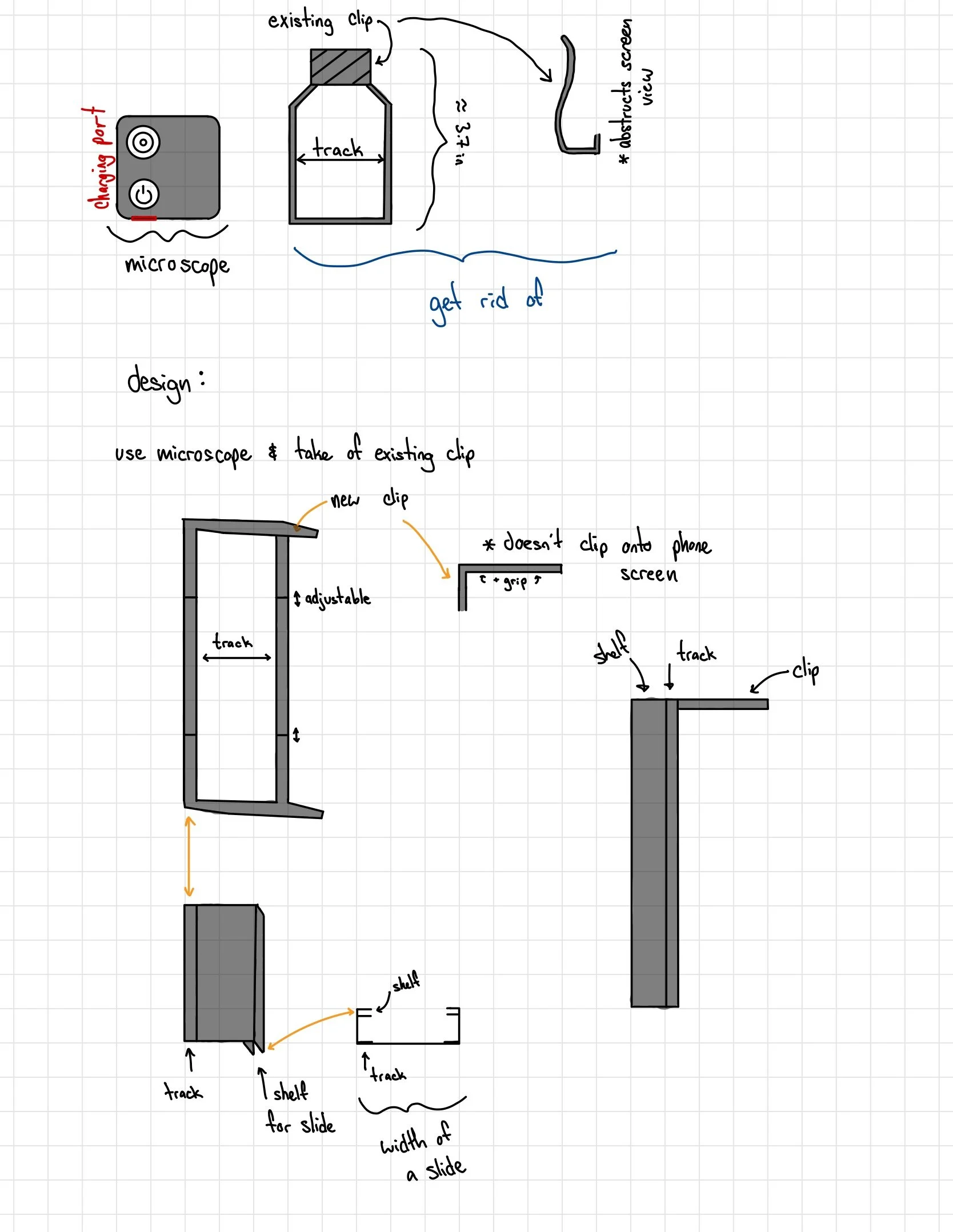
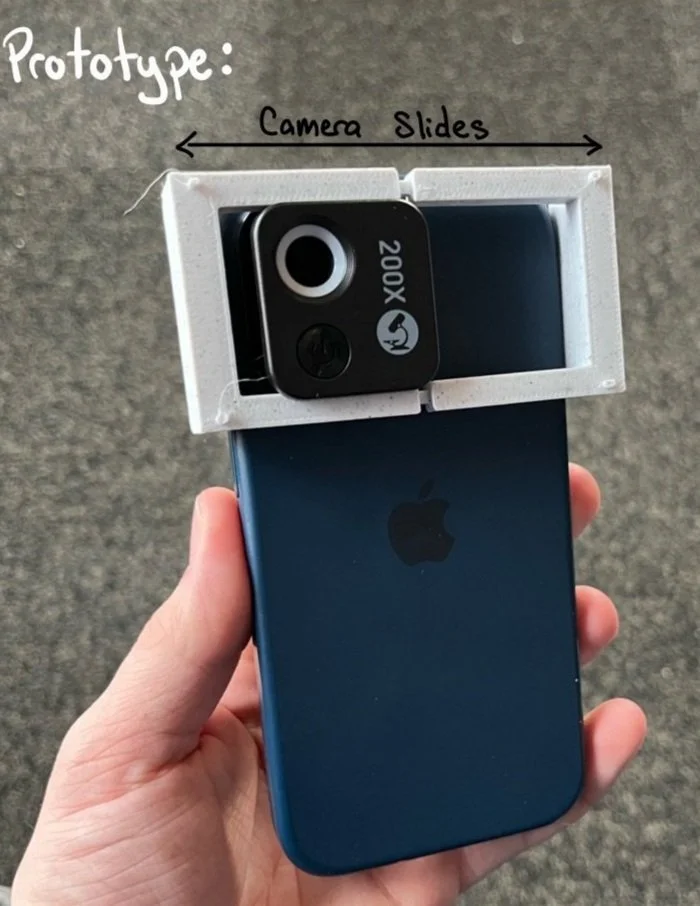
Based on these findings, I led the pivot to a sliding clip mechanism inspired by car phone mounts.
This change allowed for:
Precise adjustment for different camera placements.
Secure attachment to a variety of phone models.
Prototyping and Refinement
I sketched initial concepts for a two-piece sliding clip mechanism, connected by elastics or springs for adjustability. The key innovation was integrating the microscope lens directly into the sliding mechanism, enabling users to align it accurately over the camera.
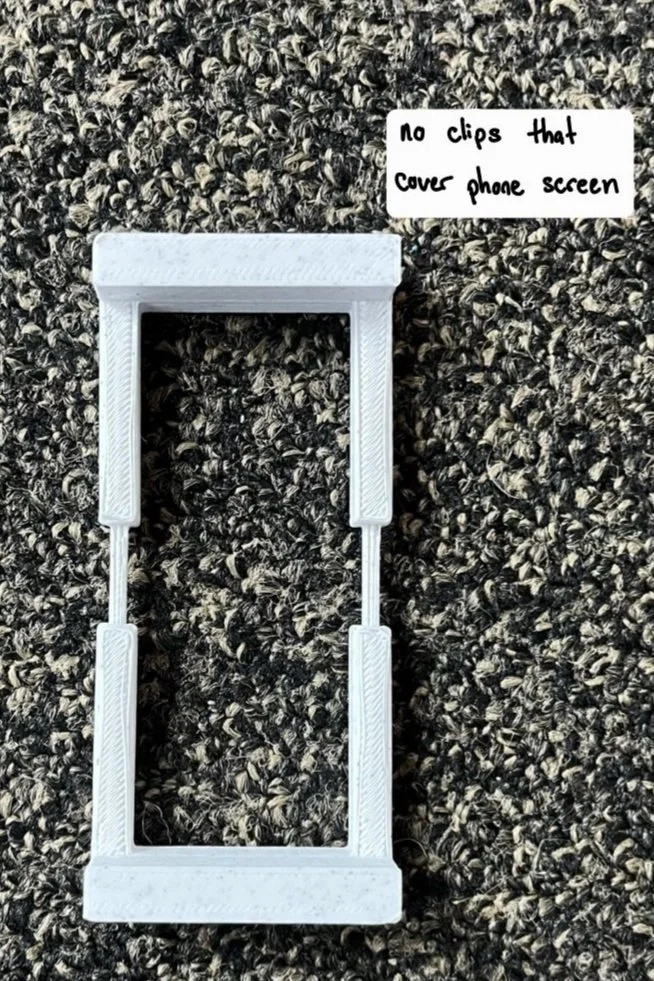
We created prototypes using 3D-printed materials, iterating based on feedback from team discussions and usability testing. Each iteration focused on improving:
Universal Fit: Ensuring the clip adapted to different phone sizes and camera placements.
User Experience: Making the mechanism intuitive and easy to assemble.
Enhancing the elasticity of the sliding mechanism for smoother adjustments.
Stability: Addressing potential wobbling or misalignment during use.
Testing involved both team feedback and real-world trials with Amazon-purchased microscopes to address issues like screen obstruction and scratch risks.
Implementation
To test the effectiveness of the final design, we conducted trials with a broad range of participants from different demographics. These included:
• Different Phone Models: We tested the design with both iPhones and Android phones to ensure universal compatibility. Phones from various manufacturers (e.g., Samsung, Google, Apple) were used to ensure the product could fit a wide range of devices.
• Diverse User Base: We sought feedback from a wide range of users, including students, parents, educators, and healthcare professionals, in order to understand the product’s usability across different contexts.
The testing process involved:
• Product Testing: Users were asked to attach the microscope to their phones, adjust the position, and use it to capture images.
• Feedback Collection: Participants were given a survey with questions about the ease of attachment, image clarity, and overall functionality. They were also asked whether they would consider using the product on a regular basis.
The survey asked users to rate the following:
1 Ease of Use: How easy was it to attach the microscope to the phone? Did it fit securely?
2 Image Quality: Was the image clear or blurry? How satisfied were users with the level of magnification?
3 Portability: Was the product easy to carry around and use in different environments?
4 Overall Satisfaction: Would users recommend the product to others?
Evaluation
To evaluate the success of the design, we analyzed both quantitative and qualitative data:
1 Quantitative Feedback: Survey responses were used to calculate overall user satisfaction. Key metrics included ease of use, image quality, portability, and overall satisfaction. A clear image quality benchmark was established, and we compared the maximum magnification achieved by the smartphone camera with the clarity of the images.
2 Qualitative Feedback: Open-ended responses provided insight into the user experience. Suggestions for improvement included making the sliding mechanism smoother, improving stability, and enhancing the zoom function.
3 Health Professional Feedback: As a long-term goal, we aimed to have the product reviewed by healthcare professionals working in low-resource settings, such as in rural or underserved areas. This would provide further insight into the microscope's potential for medical use, such as examining samples or diagnosing conditions in remote areas.
Based on user feedback, future improvements might include:
• Enhanced Zoom Functionality: While the phone's native zoom function works well, further refinement could allow for a more precise and adjustable zoom mechanism.
• Design Adjustments: Based on feedback, we could explore ways to improve the sliding clip mechanism for smoother and more secure attachment.
• Durability Testing: Additional testing in extreme environments (e.g., fieldwork, outdoor exploration) could ensure that the design remains functional under various conditions.
Final Design
The final design featured a sliding clip mechanism that could be securely attached to any smartphone, positioning the microscope lens precisely over the camera. Key features included:
Universal Compatibility: Adaptable to any phone size or model.
Intuitive Use: Easy assembly with minimal instructions needed.
Enhanced Portability: Compact and lightweight design, ideal for fieldwork.
This design successfully addressed the primary limitations of existing products, making the microscope more accessible and user-friendly.
Reflection and Future Directions
Leading the design of this project was an incredibly rewarding experience. It required balancing innovation with practicality, ensuring the product was not only functional but also intuitive and inclusive. As the design lead, I took ownership of the creative direction, driving the transition from concept to prototype and ensuring every detail aligned with our goals.
Looking ahead, I would like to explore further improvements to the design by creating additional prototypes for user testing. For example,
Integrate More User Feedback: Refine the device to be more user-friendly.
Enhanced Zoom: Refining the zoom mechanism for greater precision.
Durability Testing: Ensuring resilience in extreme environments.
Cost Optimization: Exploring affordable materials to make the product accessible to even more users.
This experience reinforced my passion for designing with empathy and accessibility in mind, proving that thoughtful design can transform even the simplest tools into solutions that work for everyone.
Feedback
References
[1] “Automated screening of sickle cells using a smartphone-based microscope ...” [Online]. Available: https://ieeexplore.ieee.org/document/9192581. [Accessed: 18-Mar-2023].
[2] “Automatic extraction of dermatological parameters from ... - IEEE xplore.” [Online]. Available: https://ieeexplore.ieee.org/document/8856720/. [Accessed: 18-Mar-2023].
[3] “How to find doctors' email addresses for free,” Carevoyance. [Online]. Available: https://www.carevoyance.com/blog/doctors-email-addresses-free#:~:text=Visit%20the%20practice%20or%20health,hackers%20can%20easily%20access%20them. [Accessed: 17-Mar-2023].
[4] “IPhone size comparison chart: Ranking them all by size...,” Know Your Mobile, 07-Mar-2023. [Online]. Available: https://www.knowyourmobile.com/user-guides/iphone-size-comparison-chart/. [Accessed: 16-Mar-2023].
[5] K. S. Lorenz, “Microscopy image analysis,” " Microscopy Image Analysis ". [Online]. Available: https://engineering.purdue.edu/~micros/. [Accessed: 17-Mar-2023].
[6] “Mobile microscopes: How your cell phone can save lives,” USC Viterbi School of Engineering, 03-Nov-2017. [Online]. Available: https://illumin.usc.edu/mobile-microscopes-how-your-cell-phone-can-save-lives/. [Accessed: 17-Mar-2023].
[7] “Phases of clinical trials,” MD Anderson Cancer Center. [Online]. Available: https://www.mdanderson.org/patients-family/diagnosis-treatment/clinical-trials/phases-of-clinical-trials.html. [Accessed: 17-Mar-2023].
[8] “PNNL smartphone microscope,” Smartphone Microscope. [Online]. Available: https://www.pnnl.gov/available-technologies/pnnl-smartphone-microscope. [Accessed: 16-Mar-2023].
[9] S. O. Isikman, S. Seo, I. Sencan, O. Mudanyali, T. W. Su, W. Bishara, A. Erlinger, and A. Ozcan, “High-throughput blood analysis on a chip using lensless digital holography,” Research Profiles at Washington University School of Medicine, 01-Jan-1970. [Online]. Available: https://profiles.wustl.edu/en/publications/high-throughput-blood-analysis-on-a-chip-using-lensless-digital-h. [Accessed: 17-Mar-2023].
[10] “Using Android application to turn smart device into digital microscope ...” [Online]. Available: https://ieeexplore.ieee.org/document/8281919. [Accessed: 18-Mar-2023].